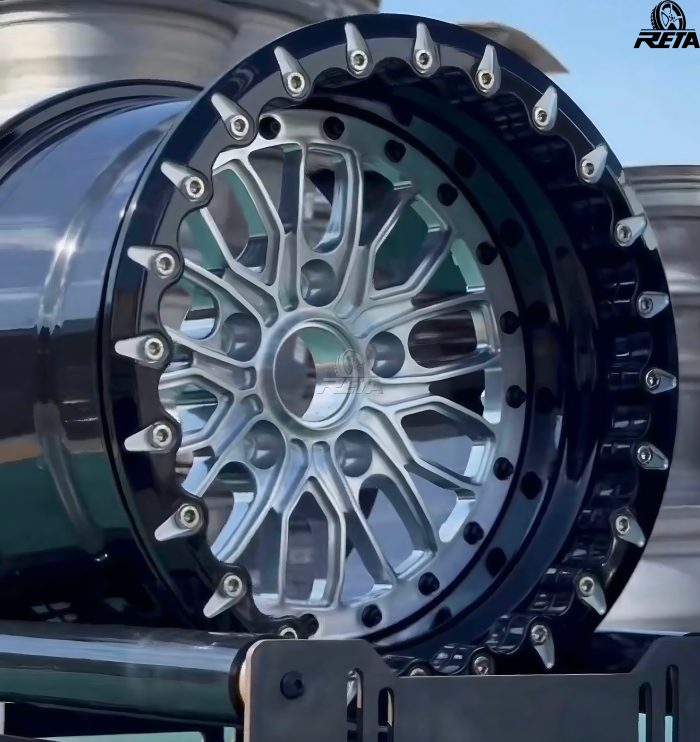
How a real beadlock clamps a tyre, why so many wheels only imitate the look, what pressure ranges make the hardware worthwhile, and which specification details decide whether the wheel survives a season of rock and sand.
Beadlock forged wheels solve a problem that has nothing to do with appearance: at low tyre pressure the bead can slip off the rim under side load, and a wheel that clamps the bead mechanically keeps the tyre seated when air pressure alone cannot. Everything else about the product, including the bolt circle around the rim, the ring thickness, the torque pattern and the maintenance routine, exists to make that clamp reliable.
The market complicates this because two very different products share the same visual language. A functional beadlock has a split rim with an outer ring that pinches the tyre bead against the wheel flange. A simulated beadlock has a decorative ring bolted to a conventional one-piece rim, with no clamping function at all. Both can look convincing in a photograph, and the price difference tells the buyer which one they are looking at long before the specification sheet does.
This article explains the construction of a real beadlock in enough detail to specify one, the off-road conditions where it earns its weight and maintenance burden, the customization that remains available once the clamping geometry is fixed, and the inspection points that separate a wheel built for desert use from a wheel built to look like it was.
How a Functional Beadlock Holds a Tyre
A functional beadlock wheel is a two-part assembly at the outer flange. The tyre bead sits on the wheel's outer seat, a ring is placed over the bead, and a circle of bolts pulls the ring down onto the flange so the bead is trapped between two metal surfaces. The clamp force, not the air pressure, is what keeps the bead in place.
The inner bead normally relies on air pressure and rim geometry, which is why many off-road beadlock designs clamp only the outer bead. A true double beadlock clamps both, using a split rim with an inner ring or a grooved insert, and it is a significantly more complex part. Buyers running extreme rock sections at very low pressure should know which of the two they are ordering.
The ring itself carries the load path. It has to be stiff enough to distribute bolt preload evenly around the circumference, because a flexible ring lets the bead migrate between bolts under side load. Forged rings are used on serious wheels for that reason: a forging holds thickness tolerance around the full circle, while a machined plate can vary enough to change the clamp pattern.
Fastener specification matters as much as ring stiffness. The bolts are loaded in tension and are exposed to mud, salt and pressure washing, so coating and grade both matter. A ring held by under-specified hardware is the most common failure point on a low-cost beadlock, and it usually fails during installation rather than on the trail.
Where Beadlock Forged Wheels Change Off-Road Performance
Traction on loose ground comes from a long contact patch, and a long contact patch comes from low pressure. A tyre at 1.0 bar spreads over sand and rock far better than the same tyre at 2.2 bar, but at that pressure a conventional bead can roll off under a side load, especially on a heavy vehicle with a wide tyre. Beadlocks exist to make that pressure range usable.
The second benefit is recovery from a debeaded tyre in the field. With a clamped bead, a trail repair usually means re-inflating rather than breaking the bead down with hand tools in soft ground. That difference matters on a group trip where the vehicle blocking the convoy is the one that needs the longest repair.
The third benefit is bead seat protection on rocky terrain. The ring acts as a sacrificial lip, so impacts that would deform a conventional flange hit a replaceable part instead. On a wheel with a forged ring this is a genuine service advantage, since the ring can be swapped without replacing the barrel.
The costs a buyer accepts with a functional beadlock:
- More mass at the outer rim, where it has the largest effect on inertia and unsprung mass
- A torque check routine on every ring bolt, repeated after the first heat cycle and after hard use
- A wheel that is not street legal in several markets, regardless of how well it is made
Functional, Simulated and Hybrid Designs
A simulated beadlock is a one-piece wheel with a cosmetic ring. It carries no clamp load, the bolts are decorative or thread into blind holes, and the tyre is mounted conventionally. It is lighter, cheaper, legal on the road in most markets, and it delivers the visual proportion that buyers want without the maintenance routine.
A hybrid design sits between the two: a ring that is bolted through the flange and provides some bead retention without a full split-rim clamp. These appear on wheels sold for light off-road use, and their capability depends entirely on how the ring contacts the bead. The specification should state that contact geometry, not just the bolt count.
Choosing between them is a question of use, not budget alone. A vehicle that spends most of its life on tarmac and occasional gravel does not need a functional beadlock, and fitting one adds mass, maintenance and legal risk for no benefit. A vehicle that runs dunes or rock trails at low pressure does need one, and a simulated ring will not substitute no matter how it is described in a listing.
Our forged beadlock wheel ring range is produced as a separate component for exactly this reason: a buyer can specify the ring material and finish independently of the wheel, and a damaged ring can be replaced without retooling the barrel.
Specification Details That Decide Durability
The first detail is ring thickness and its relationship to bolt spacing. A ring with bolts every 50 millimetres behaves differently from one with bolts every 70 millimetres, because the unsupported span between fasteners is where the bead can creep. Buyers should ask for the bolt count, the ring thickness and the specified torque, and check that the three were designed together rather than assembled from available parts.
The second is the flange seat surface. A bead needs a clean, concentric seat with the correct roughness to grip without cutting. A machined seat that is too smooth lets the bead slip; one that is too rough initiates a tear at the bead heel. The finish specification on that surface is a manufacturing detail buyers rarely see, and it is one of the clearest differences between a purpose-built wheel and a converted one.
The third is valve and inflation provision. A beadlock with a clamped outer bead needs a valve position that stays accessible with the ring fitted, and some designs add a second port for rapid deflation and re-inflation. That port is a small feature that transforms the usability of the wheel on a trail, and it is usually absent from cosmetic versions.
The fourth is load rating relative to tyre size. A 37-inch tyre on a built vehicle produces bending loads at the bead seat that a passenger-car rating does not describe, and the wheel's rating has to be stated for the tyre diameter and vehicle mass actually in use. A beadlock ring does not raise the structural rating of the barrel behind it.
| Specification | Typical Range | Why the Number Matters |
|---|---|---|
| Ring bolt count | 18 to 40 depending on diameter | Sets the unsupported span where the bead can creep |
| Ring material | Forged 6061-T6 or 7075 | Controls stiffness and how evenly preload is distributed |
| Bead seat finish | Machined with controlled roughness | Too smooth slips, too rough tears the bead heel |
| Bolt grade and coating | High-tensile, corrosion protected | Mud and salt attack hardware before they attack the wheel |
| Valve arrangement | Single or dual port with ring fitted | Determines how fast pressure can be adjusted on the trail |
| Load rating statement | Tied to tyre diameter and vehicle mass | A ring does not increase the strength of the barrel behind it |
Customization Options Within a Beadlock Programme
Customization on a beadlock splits cleanly into two tiers: what can be changed on an existing tool, and what requires a new forging. Diameter, width, offset, bolt pattern, centre bore, ring colour and ring finish are all machining or finishing variables. Spoke design, window shape and the ring's bolt pattern are structural choices that require new tooling.
- Ring finish. Contrast rings are the most visible customization on this product, and a painted ring with a machined face is easier to maintain than a full polish.
- Bead seat colour. Machined seats show bright metal after mounting; a dark anodised seat hides the marks that mounting inevitably leaves.
- Bolt hardware. Colour-matched or stainless hardware changes the perceived quality of the ring more than any other single detail.
- Centre cap and logo engraving. These are finishing operations and do not affect fitment, which makes them safe to change late in a programme.
- Ring replacement supply. A buyer running hard use should establish that replacement rings and hardware can be ordered separately, because that availability determines the real service life of the wheel.
One customization request deserves a caution. Buyers sometimes ask for the maximum number of ring bolts because it looks more serious. Past a certain point the extra fasteners add installation time and clamping inconsistency without improving bead retention, because the ring stiffness and seat geometry are already doing the work. The correct bolt count is the one the design was calculated around.
Weight, Balance and Highway Manners
Mass is the first thing a road-biased buyer notices about a functional beadlock. The ring, the bolts and the reinforced flange sit at the outermost radius of the wheel, which is the worst possible place for extra weight: it raises rotational inertia in proportion to the square of the radius, and it adds directly to unsprung mass. On a vehicle that already runs a heavy off-road tyre, the combined effect is a slower response over sharp bumps rather than a dramatic change in outright acceleration.
Balance is the second consideration and it is a production issue rather than a design one. A ring and bolt circle add an assembly that has its own mass variation, and if the ring is indexed to the wheel without a recorded orientation, a technician refitting it after a tyre change may not recreate the original balance. Marking the ring position before disassembly is a small habit that saves a rebalance.
Highway behaviour is the third. A clamped bead is stiffer at the flange than a conventional bead seat, so the tyre's sidewall transition is slightly different and some drivers report a firmer feel over expansion joints. The effect is small compared with the tyre choice itself, but it is real, and it is one reason a beadlock wheel is usually paired with a tyre selected for the same duty rather than with a road-oriented pattern.
Noise is worth mentioning because it is rarely discussed in specifications. The ring and hardware create a small cavity at the flange that can trap water and debris, and on a wet road the assembly throws that material outward. Buyers who use the vehicle daily in a wet climate should expect more cleaning around the ring than around a conventional lip, and a smooth ring profile is easier to keep clear than a heavily styled one.
For a brand selling into both segments, the practical answer is to keep two specifications in the catalogue rather than one compromise. A simulated design covers the buyers who want the proportion for daily use, and a functional design covers the buyers who actually run low pressure. Mixing the two in a single product produces a wheel that is heavier than it needs to be and not strong enough where it matters.
Installation, Torque and Maintenance Routine
Mounting a beadlock is a sequence, not a single operation. The tyre is seated on the flange, the ring is positioned, and the bolts are brought down in stages following a star pattern so the ring compresses evenly. Tightening one side to final torque before the others are snug distorts the ring and produces an uneven clamp that shows up later as a slow leak or a creeping bead.
After the first heat cycle, the assembly should be re-torqued. Bolts settle as the ring beds into the bead and the coating compresses, and the torque loss is normal rather than a defect. The same check is required after any hard use, which is why beadlock ownership is described as a maintenance commitment rather than a one-time purchase.
Leak diagnosis follows the same logic. Air escaping at a ring bolt usually indicates uneven preload or a damaged seat, not a failed bolt. Soap solution applied around the circumference while the wheel is inflated will show which sector is leaking, and the fix is to release the ring and inspect the bead and seat rather than to keep tightening.
Inspection Points for Buyers Auditing a Supplier
Ask for the ring's flatness measurement. A ring that is not flat clamps unevenly no matter how carefully it is installed, and flatness is cheap to check on a surface plate. Ask for the bolt hole position tolerance as well, because a pattern that is slightly out of position pulls the ring sideways as the bolts tighten.
Ask which test sequence was applied and at what load, and ask whether the test was performed with the ring fitted. A beadlock assembly behaves differently from the bare wheel, so a report that covers only the wheel does not describe the product being sold.
Ask for a torque specification in writing, with the fastener grade it applies to. A supplier that cannot state a torque value has not designed the joint, and the buyer inherits that uncertainty on the first installation.
Finally, ask about ring availability as a spare part and the lead time for a replacement. For a product whose main wear item is a bolted ring, spare-part supply is a better indicator of long-term support than any catalogue photograph.
A fifth question concerns coating on the bolt holes and threads. Threads that are painted after machining lose their specified fit, and threads left bare corrode in a wet climate. The correct arrangement is a coated head with a protected thread, and a supplier who can describe that arrangement has thought about installation rather than only about the finished appearance.
How RETA Produces Beadlock Forged Wheels
RETA has manufactured forged wheels in Ningbo since 2012, with the company founded in 2009, a 12,000 square metre plant and more than 100 staff. Off-road and beadlock work runs alongside the road-car range, using 6061-T6 and 7075 billet selected against the load class of the vehicle rather than against the diameter alone.
The quality system covers ISO 9001, ISO 14001, ISO 45001 and IATF 16949, with national high-tech enterprise status granted in 2021. Internal limits are held tighter than the SAE, JWL and PCT requirements we design to, and 30-degree and 90-degree impact and deformation tests are added because off-road damage rarely arrives as a single clean radial load.
The minimum order is one set of four wheels, standard sizes run in roughly 7 to 15 working days, and fully custom designs take about 25 to 35 working days. Most off-road programmes start from the SSD off-road series and move to a private design once the fitment list and tyre sizes are settled.
We exhibit at SEMA, where the brand received the 2023 Best Innovative Wheel Brand Award, and off-road buyers there tend to arrive with a tyre size and an inflation strategy rather than a style reference. That is the right order: the customized off-road forged wheel can then be specified around the pressure the customer actually intends to run.
Frequently Asked Questions
Q1. Are beadlock forged wheels legal on the road?
In many markets a functional beadlock is restricted to off-road use because the ring and fastener circle are not part of the type approval for the vehicle. Simulated beadlock wheels avoid that problem because they are a single conventional rim. Buyers exporting to a specific country should confirm the local position before committing to a functional design.
Q2. What tyre pressure can a beadlock safely hold?
The usable range depends on the tyre, the vehicle mass and the ring design, and it should be stated by the manufacturer for the specific assembly. The general principle is that the clamp allows pressure well below what a conventional bead tolerates, but the tyre's own sidewall and the rim width set the lower practical limit.
Q3. How often do beadlock ring bolts need re-torquing?
At minimum after the first heat cycle and after any hard off-road use, following the torque pattern supplied with the wheel. A ring that repeatedly loses preload indicates a seating problem rather than normal settling, and it should be inspected rather than simply tightened again.
Q4. Does a beadlock ring add strength to the wheel?
It adds protection at the outer flange and it clamps the bead, but it does not raise the structural rating of the barrel or the spokes. A wheel that is under-specified for the vehicle remains under-specified after a ring is bolted on, which is why load rating and ring design have to be considered together.
Q5. Can a simulated beadlock be converted to a functional one?
No. A functional beadlock requires a split rim with a clamping seat and a ring designed to carry preload, so conversion means a different wheel rather than an added part. A cosmetic ring bolted to a one-piece rim cannot be upgraded into a clamp by changing hardware.
Send us your tyre size, intended pressure range and vehicle mass, and we will specify beadlock forged wheels with the ring, bolt pattern and load rating matched to how the vehicle is actually used.
View Heavy-Duty Wheels Discuss a Build