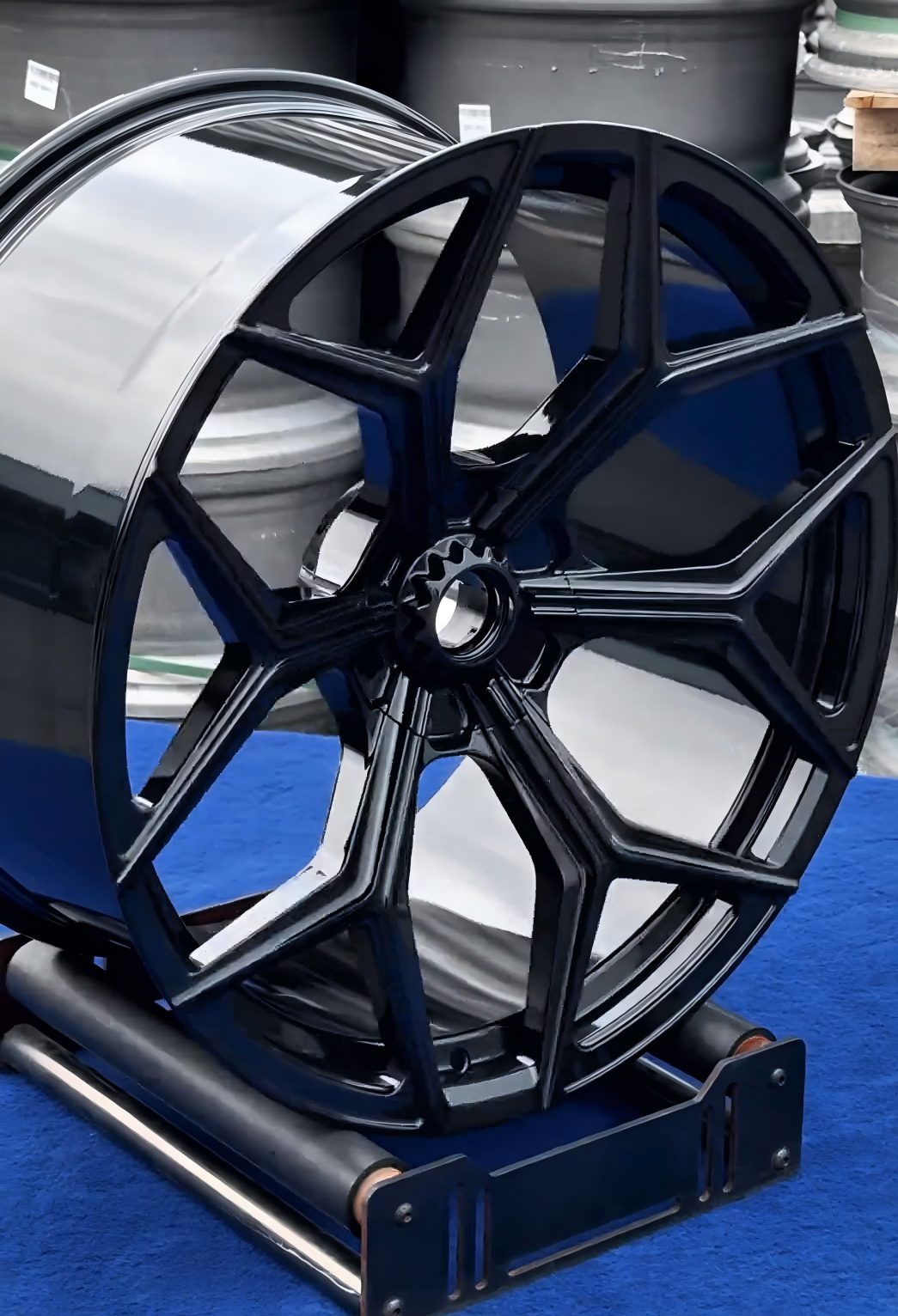
One nut instead of five, a spline instead of studs, and a torque figure that changes how the whole wheel has to be designed, converted and maintained.
Center lock forged wheels replace the conventional bolt circle with a single central nut that clamps the wheel to a splined hub. The layout comes from endurance racing, where a pit stop is measured in seconds and every fastener removed is time lost. It migrated into road cars through performance models, and it has since become a styling signal as much as a functional choice.
The engineering consequences are larger than the visual change suggests. A single nut has to produce the same clamp load as four, five or six fasteners, which means a much higher torque, a much larger thread, a splined interface to carry drive torque, and a hub thick enough to take the load without distortion. Every one of those requirements flows back into the wheel design.
This article explains the hardware, why the format is used in competition, what a road car actually needs in order to run it safely, where the design limits appear, and how a buyer should assess a center lock programme without confusing a conversion kit with a properly engineered hub.
What a Center Lock System Consists Of
The system has four parts: the hub with its external spline, the wheel with a matching internal spline, the central nut that clamps the wheel against the hub face, and a retention device that prevents the nut from rotating. Each part has to be designed with the others in mind, which is why mixing components from different sources is the most common cause of problems.
The spline carries drive torque rather than the nut. That distinction matters: in a conventional wheel the friction between hub and wheel, generated by the stud clamp load, transmits torque, while in a center lock system the spline does it mechanically. The nut only has to hold the wheel against the hub face, which is why the spline fit is a critical tolerance and not a locating convenience.
The nut itself is usually a large hexagon or a multi-pin drive in a high-strength aluminium or titanium alloy, with a captive washer that bears on the wheel face. A poorly made nut damages the wheel face as it tightens, and a nut with the wrong thread engagement cannot develop the clamp load the hub was designed for.
Retention is the part owners underestimate. Racing systems use a spring clip, a locking plate or a pin that physically prevents rotation. Road conversions sometimes rely on thread friction alone, which is exactly the assumption that fails when a nut is left slightly under-torqued after a wheel change.
| Component | Function | Failure if Under-Specified |
|---|---|---|
| Hub spline | Transmits drive and braking torque | Spline wear, fretting and eventual rotational play |
| Wheel spline | Engages the hub and centres the wheel | Loose fit, vibration and damaged teeth |
| Central nut | Generates clamp load against the hub face | Loss of preload, wheel movement under cornering |
| Washer face | Distributes clamp load on the wheel | Galling and crushing at the wheel face |
| Retention device | Prevents the nut from rotating loose | A nut that backs off is a wheel that leaves the car |
| Drive tool | Applies the specified torque accurately | Under- or over-tightening with no way to detect either |
Why Racing Uses Center Lock, and What Transfers to the Road
The original reason is pit-stop speed. A single nut can be released and re-torqued with one tool in one motion, while a five-stud pattern needs five operations and a torque sequence. In endurance racing that difference is measured in seconds per stop, and over a long race it becomes a position on the grid.
The second reason is structural. A single large nut applies clamp load through a washer with a large bearing area, which produces a more even pressure distribution on the wheel face than five smaller fasteners. That reduces local distortion at the mounting face and keeps the brake disc running true under heavy use.
The third reason is mass, though the saving is smaller than marketing suggests. Removing four or five studs and nuts does save weight, but the hub has to be larger and the nut is heavier than a single lug nut, so the net gain is modest. The real advantage is the reduced parts count, which matters in a race environment where every component is inspected.
What transfers to the road is the convenience and the look, not the pit-stop logic. A road driver changes a wheel a few times a year, so the time saved is irrelevant. What remains is the engineering requirement: a proper hub, a properly specified nut, and a discipline about torque that most road owners have never had to learn.
What a center lock conversion changes on a road car:
- The wheel can no longer be fitted with a standard lug wrench, so a failure away from home is a recovery rather than a roadside change
- The torque value is several times higher than a conventional wheel, which requires a suitable wrench and a calibrated setting
- Every service that removes a wheel now depends on the technician following the retention procedure
Compatibility: What a Vehicle Actually Needs
A vehicle built with center lock from the factory has a hub designed for it: a splined nose, a large thread, a bearing package sized for the clamp load and a body structure that accepts the resulting loads. A conversion adds an adapter that bolts to the original hub and presents a center lock interface, and the quality of that adapter decides whether the result behaves like the original design.
The first compatibility question is spline engagement length. An adapter that is too thin gives the wheel spline less engagement than the design requires, which concentrates load on fewer teeth and accelerates wear. The second is the thread class and material of the adapter's centre thread, because that thread carries the entire clamp load through a single interface.
The third is the wheel's own hub thickness. A center lock wheel needs a deeper centre section to accommodate the spline and the nut seat, and that depth has to clear the brake caliper and the adapter without moving the wheel outboard. On a car with large brakes, that packaging problem is usually the limiting factor.
The fourth is the retention method. A road conversion should use a nut with a positive mechanical retention, not friction alone, and the owner should know how it works. Our single hole center lock cover is a good example of how the visible hardware and the retention detail have to be designed together rather than assembled afterwards.
Torque, Preload and the Discipline It Requires
A center lock nut is typically tightened to a figure in the region of several hundred newton metres, far above the 110 to 140 newton metres of a conventional car wheel. That is not because the nut is larger for its own sake; it is because one fastener has to generate the clamp load that four or five would otherwise share, across a bearing area that has to distribute it evenly.
The practical consequence is that a standard workshop torque wrench is inadequate. A long-handled tool or a torque multiplier is required, and it has to be calibrated, because an error of ten percent at this load level is a much larger absolute error than at a conventional torque. A shop that tightens by feel on a center lock is not tightening to specification at all.
Lubrication of the thread and the washer face is part of the specification, not a workshop preference. Dry threads and lubricated threads develop different clamp loads at the same torque, and a nut specified for a dry assembly that is fitted with grease will be under-tightened by a significant margin. The supplier should state the lubrication condition along with the torque figure.
Re-checking is the final discipline. A center lock nut should be verified after the first drive following a wheel change and at defined service intervals, because the joint settles as the surfaces bed in. A nut that repeatedly loses preload indicates a worn washer, a damaged thread or a hub face that is not flat, and none of those conditions improve with repeated tightening.
Design Constraints on the Wheel Itself
The centre of a center lock wheel is structurally busier than a conventional one. It has to contain the spline, the nut seat, the washer bearing surface and enough material around all three to carry the clamp load into the spokes. That usually means a thicker hub section and a spoke root that starts further outboard than on a studded wheel.
The second constraint is spoke clearance around the nut. A design with a very tight centre and long slender spokes can leave no room for the drive tool, which makes the wheel impossible to torque in place. Buyers should check the tool envelope against the spoke layout before approving a design, because this is a problem that only appears when the wheel is on the car.
The third is brake clearance at the centre. A deep concave face moves material inboard toward the caliper, and a center lock hub already occupies more axial space than a studded hub. The combination is where most fitment conflicts occur, and it is resolved in the 3D assembly rather than on the vehicle.
The fourth is load rating. A single central joint concentrates stress differently from a distributed bolt circle, and the hub region has to be validated as a system with the adapter rather than as a wheel on its own. A test report that covers only the wheel does not describe the assembly a customer will actually drive.
Customization on a Center Lock Programme
The center lock interface itself is fixed once the hub and spline are chosen, so customization happens around it. Diameter, width, offset, spoke design, window shape, concave depth and finish all remain available, provided the centre section stays deep enough to house the spline and the nut seat.
- Nut finish. A coloured or anodised nut is the most visible detail on the wheel and the easiest to change late in a programme.
- Centre cap treatment. A cover that hides the nut entirely changes the character of the wheel and is a popular option on road cars.
- Spoke architecture. Five-spoke and split-spoke layouts give the drive tool the most clearance; dense multi-spoke designs need a deeper centre.
- Finish combinations. Brushed, polished, painted and two-tone treatments all work, though the centre area is harder to polish and easier to keep clean in a painted finish.
- Adapter and nut supply. Establishing that the adapter, nut, washer and retention parts can be reordered as a set is more important than any cosmetic choice.
One request to handle carefully is a center lock look on a car that keeps its studs. A cover or a fake nut can produce the appearance without the conversion, and for many road owners that is the rational choice: it keeps the standard tooling, the standard torque and the standard service routine while delivering the visual proportion they wanted.
Roadside Reality and Service Ownership
The most underrated consequence of a center lock conversion is what happens after a puncture. A conventional wheel can be changed at the roadside with the tool in the boot. A center lock wheel needs a high-torque tool that most owners do not carry, which turns a fifteen-minute wheel change into a recovery call. That is a real ownership cost, and it should be explained to the customer before the conversion rather than after the first flat.
For a brand selling conversions, the practical response is to supply a suitable tool as part of the kit and to document the procedure clearly. A kit that includes the nut, the adapter, the retention parts and the correct wrench is a product; a kit that includes only the adapter and leaves the owner to source a tool is an unfinished one.
Service ownership has a second dimension: technician training. A workshop that has never handled a center lock wheel may tighten it with a standard wrench, reuse a deformed washer or skip the retention clip. Those are not malicious errors, they are knowledge gaps, and they are the reason some brands restrict conversion sales to approved fitting partners.
The third dimension is parts availability over time. A nut, washer or retention clip that cannot be reordered after two years turns a serviceable wheel into a decorative object. Buyers should establish spare-part supply at the point of purchase, and treat it as a condition of the programme rather than a favour requested later.
None of this argues against the format. It argues for selling it as a system with a documented routine, to a customer who understands what has changed. Brands that do that report few problems; brands that sell a look and leave the engineering to the buyer generate the failure stories that make the whole category look risky.
A short handover document is the cheapest risk control available: the torque figure, the lubrication condition, the retention check, the tool required and the re-check interval, on one page, in the box. It costs nothing to produce and it prevents the most common cause of a loose nut, which is a fitter who simply did not know.
Inspection and the Counterfeit Risk
Center lock hardware is a safety-critical part that is easy to copy visually and hard to copy metallurgically. A nut that looks correct but is made from a lower grade alloy, or heat treated to a lower strength, will deform at the specified torque and lose preload. Buyers should treat the nut and adapter as engineering parts rather than accessories and ask for material certificates.
Spline wear is the second inspection point. Fine fretting marks at the tooth flanks are normal in service; loose fit, rocking or visible tooth deformation are not, and they indicate that the spline was under-designed or the nut was run loose. A wheel with a worn spline should be replaced rather than refitted.
The wheel face under the washer is the third. Galling, a polished ring or a depression at the contact area shows that the washer was rotating against the wheel or that the bearing area was too small. That damage progresses quietly until the nut can no longer hold its torque.
The fourth check is documentation of the assembly test. A supplier should be able to show that the wheel, adapter and nut were tested together at the rated load, and that the torque specification was validated on that assembly. Anything less leaves the buyer to conduct the validation on a customer's car.
How RETA Produces Center Lock Forged Wheels
RETA has built forged wheels in Ningbo since 2012, with the company founded in 2009, a 12,000 square metre plant and more than 100 staff. Center lock programmes run through the same forging, machining and finishing lines as the studded range, with the hub geometry machined to the spline and thread specification of the intended system.
The quality system covers ISO 9001, ISO 14001, ISO 45001 and IATF 16949, with national high-tech enterprise status granted in 2021. Internal limits are held tighter than the SAE, JWL and PCT requirements we design to, and 30-degree and 90-degree impact and deformation tests are added because a single central joint loads the hub differently from a distributed bolt circle.
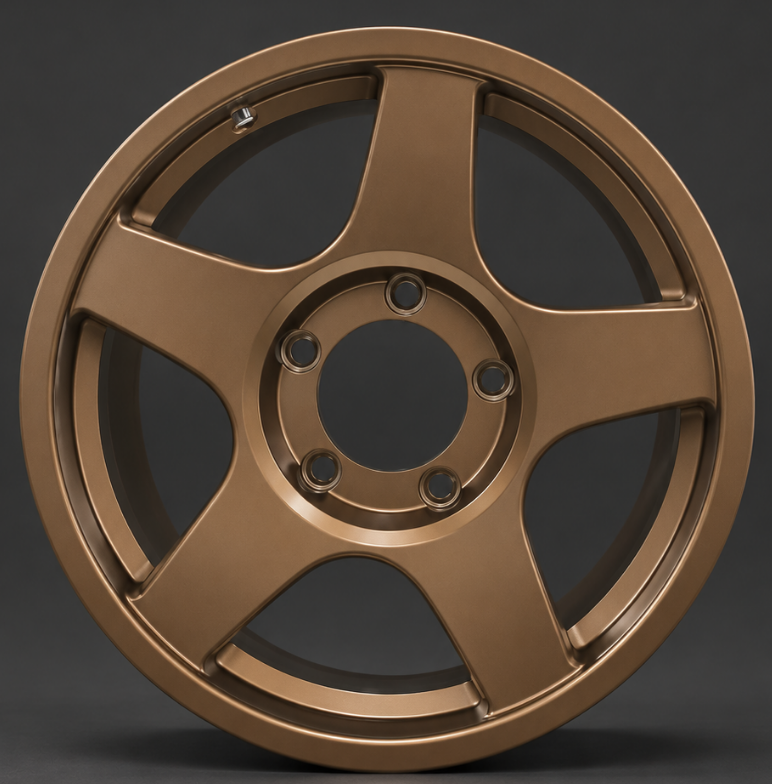
Commercially, the minimum order is one set of four, standard sizes run in roughly 7 to 15 working days and fully custom designs take about 25 to 35 working days. Buyers often start from the six spoke center lock forged wheel because the open spoke layout leaves generous tool clearance, and move to a private design once the fitment list is fixed.
We exhibit at SEMA, where the brand received the 2023 Best Innovative Wheel Brand Award, and center lock enquiries there usually arrive with a photograph and a question about adapters. That is the right conversation to have before a design is approved, because the RC1 one hole center lock forged wheel can be specified against the actual hub rather than against an assumption.
Frequently Asked Questions
Q1. Can any car be converted to center lock wheels?
Most cars can be converted with an adapter, but the result depends on spline engagement, hub depth and brake clearance. A conversion that compromises any of those three is not worth doing, and a car with large brakes and a shallow hub often has no good solution without changing other components.
Q2. How much torque does a center lock nut need?
It is several hundred newton metres, far above a conventional wheel, and the exact figure must come from the system supplier along with the lubrication condition. Tightening to a figure taken from another system is one of the most common and most dangerous mistakes in a conversion.
Q3. Are center lock wheels safe for daily driving?
They are safe when the system is properly engineered and the torque routine is followed. The practical risk is human: a technician who tightens by feel, or an owner who cannot change a wheel at the roadside, is a bigger factor than the hardware itself.
Q4. Do center lock wheels save weight?
Less than expected. Removing studs and nuts saves a little, but the hub is larger and the central nut is heavier than a single lug nut. The strongest arguments for the format are speed of wheel change, even clamp load and the visual result rather than mass.
Q5. Can a center lock wheel use a standard tyre valve and TPMS sensor?
Yes, provided the valve bore and the internal clearance are designed for the sensor. The centre of the wheel is crowded on a center lock design, so sensor placement should be confirmed during design rather than discovered at the first tyre fitting.
Send us your hub dimensions, brake package and target torque, and we will specify center lock forged wheels as a system, with the adapter, nut and retention hardware matched to the vehicle rather than added afterwards.
View Monoblock Range Ask About Conversion