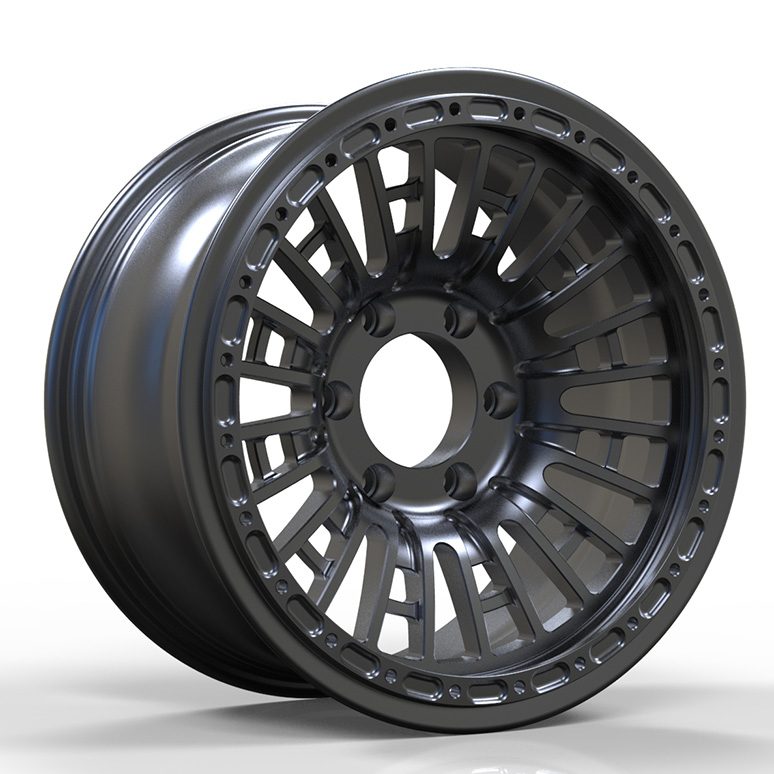
Why a kilogram removed at the wheel is worth more than a kilogram removed anywhere else, how rotational inertia differs from static mass, and where the benefit stops being real.
Unsprung mass is everything between the road and the suspension springs: the wheel, the tyre, the brake assembly, part of the suspension links and, on a driven axle, part of the driveline. Reducing it improves how quickly the suspension can respond to the road, because the spring and damper are managing less inertia at the end of their travel.
The wheel is the most useful place to reduce that mass because it is the largest single component in the group and because it also rotates. Mass at the rim has two effects at once: it loads the suspension vertically and it resists angular acceleration. A lighter wheel therefore improves both ride response and the way the car picks up speed, which is why forged wheels are specified for reasons that have nothing to do with appearance.
This article separates the two effects, quantifies roughly what a forged wheel can save, explains how that saving translates into feel rather than into a specification sheet, and sets out where the benefit stops and where a lighter wheel becomes a worse product.
What Unsprung Mass Does to a Suspension
A suspension is a control system trying to keep the tyre in contact with a surface that is moving. The spring supports the body, the damper controls the relative velocity, and the unsprung mass sits between them. Every bump sends the wheel upward, and the damper has to absorb that movement and settle it before the next input arrives.
Less unsprung mass means the wheel accelerates upward more easily and the damper can control it with less force. That produces a tyre that follows the surface more closely, which raises the average contact patch load over rough ground. The driver experiences it as a car that feels settled on a broken surface instead of skipping across it.
There is a threshold effect worth understanding. Below a certain speed the damper can control almost any wheel, so the difference is small. At higher speeds and higher input frequencies the unsprung mass becomes the limiting factor, which is why a lighter wheel is felt most on a fast, broken road and least on a smooth motorway.
The same logic explains why a heavy wheel and a stiff damper is a poor combination. Stiffening the damper to control extra mass transmits more force into the body, so the ride becomes harsh without the contact patch improving. Reducing mass is the better route to the same goal.
Rotational Inertia Is a Separate Problem
A wheel is both a mass and a flywheel. Its rotational inertia depends on how the mass is distributed, and it scales with the square of the radius, so material near the rim contributes far more than material near the hub. Two wheels of identical weight can have noticeably different inertia depending on where the material sits.
That is why a design that removes mass from the barrel and the lip is more effective than one that removes the same mass from the hub. It is also why a deep concave design, which moves material inboard, can have slightly lower inertia than a flat face of the same weight despite looking heavier.
The effect on acceleration is real but smaller than marketing suggests. In first gear, the wheel's inertia is a meaningful fraction of the total inertia the engine has to accelerate. In higher gears the driveline and vehicle mass dominate, so the benefit fades. On an electric vehicle with a single-speed reduction, the effect is present across the whole speed range, which is one reason forged wheels are popular there.
Braking is the mirror image. Less rotational inertia means less energy for the brakes to dissipate, which reduces thermal load. On a heavy vehicle that is a small effect; on a light car driven hard it contributes to more consistent pedal feel over repeated stops.
How Much a Forged Wheel Actually Saves
A forged monoblock wheel is typically lighter than a cast wheel of the same size by a margin that depends on the design and the load rating. The saving comes from the material properties allowing thinner sections, not from forging being inherently light. A poorly designed forged wheel can weigh the same as a good cast one.
The comparison that matters is against the wheel being replaced, not against an abstract ideal. A vehicle that came with a heavy cast wheel on a large diameter has the most to gain; a vehicle already fitted with a light forged wheel has very little. Buyers should weigh the existing wheel and the proposed one rather than rely on a category claim.
Tyre mass should be counted too. A larger diameter usually means a heavier tyre, and that mass sits at the outermost radius where it has the greatest effect. Upgrading to a larger forged wheel can therefore increase total unsprung mass even when the wheel itself is lighter, which is a fact that upsize-focused builds often ignore.
The honest way to evaluate a change is to compare the complete assembly: wheel, tyre, and any brake components being altered at the same time. That comparison sometimes argues for staying at the current diameter with a lighter wheel rather than moving up a size.
| Change | Unsprung Mass | Rotational Inertia |
|---|---|---|
| Same size, cast to forged | Falls, often noticeably | Falls, with the largest gain at the rim |
| Same size, forged to forged | Small, design dependent | Small, depends on mass distribution |
| Plus one inch, forged | Often rises, driven by the tyre | Rises, because tyre mass moves outward |
| Wider barrel, forged | Slight rise | Rise, with the tyre contributing most |
| Lighter brake disc | Falls, close to the hub | Falls, but less than rim mass of the same weight |
| Run-flat tyre | Rises, sometimes substantially | Rises, at the worst radius |
How Unsprung Mass Forged Wheels Change the Feel
The first change a driver notices is over high-frequency inputs: expansion joints, patched asphalt and the ridges left by resurfacing. A lighter wheel reduces the force transmitted into the body at those frequencies, so the car sounds and feels less harsh without any change to the springs.
The second is steering response over broken surfaces. With less mass at the wheel, the tyre is less inclined to skip, so the steering retains load and feel instead of going light. Drivers often describe this as the front end feeling more connected, which is a description of contact patch consistency rather than of steering ratio.
The third is body control at speed. Less unsprung mass reduces the energy the damper has to manage, which can make the body feel more stable over a series of bumps. The effect is subtle on a well-damped car and obvious on one that was already working at its limit.
The fourth is acceleration feel, which is mostly rotational inertia. A car with lighter wheels feels more eager from a standstill and on part-throttle roll-on, even when the measured difference is small. That perception is real, and it is one reason forged wheels are often the first modification an owner notices.
The Electric Vehicle Case
Electric vehicles make the unsprung mass argument more relevant, not less. A battery pack raises total vehicle mass, which means the suspension is already managing more load, and the absence of engine noise removes the masking that used to hide road noise and impact harshness. A heavy wheel on an EV is therefore more noticeable than the same wheel on a combustion car.
The instant torque of an electric motor also makes rotational inertia more relevant across the speed range. With a single-speed reduction and full torque from zero, the wheel's inertia is part of every acceleration event, not only the first few seconds. Reducing it produces a small but consistent efficiency gain as well as a feel improvement.
There is a counter-consideration: EV load ratings are higher because the vehicle is heavier, so the wheel needs more material than an equivalent combustion car. The design task is to meet that rating while keeping mass low, which is exactly where a forged monoblock earns its place. Our note on why forged wheels suit electric vehicles covers the trade-offs in more detail.
Aerodynamics is the fourth EV-specific factor. An open-spoke wheel creates turbulence that costs range at motorway speed, so a design that is light and also smooth-faced is worth more on an EV than on a car where fuel consumption is a secondary concern. The SSD new energy series is specified around that combination.
Where the mass saving is actually felt:
- Ride quality over broken surfaces, where the damper has less inertia to control
- Steering feel over camber and ridges, where contact patch consistency improves
- Throttle response at low speed, where rotational inertia is a larger share of the total
Where the Weight Sits Inside the Wheel
Two wheels of the same mass can behave differently because mass distribution, not total mass, sets rotational inertia. Material at the lip and the outer barrel is far more costly in inertia terms than the same mass at the hub, and a design that removes weight from the wrong place achieves very little.
This is where unsprung mass forged wheels earn their reputation. A forged design can hold a thin barrel and a light lip because the material properties allow it, whereas a cast wheel needs more thickness throughout to reach the same strength. The saving therefore lands precisely where it is most valuable.
A worked comparison makes the point. Moving one kilogram from the hub to the lip changes the inertia by an amount that depends on the radius squared, so at a 250 millimetre radius the same kilogram contributes many times more inertia than at the hub. That is why a wheel described as "one kilogram lighter" tells a buyer almost nothing without knowing where the kilogram came from.
Buyers comparing two designs should therefore ask about barrel wall thickness and lip design rather than only about total mass. A wheel that is slightly heavier but carries its mass inboard can accelerate better and ride better than a lighter one with a heavy rim section, and the specification sheet will not show that difference.
The same reasoning applies to brake components changed at the same time. A lighter disc saves mass close to the hub, where it affects unsprung mass but contributes relatively little to inertia reduction. That is still worthwhile, but it is a different benefit from lightening the rim, and the two should not be added together as if they were equivalent.
Where Lighter Stops Being Better
The first limit is structural. A wheel can be made light by reducing section thickness, and past a point that reduces fatigue life and impact resistance faster than it reduces mass. A design that passes a static load test but has no margin for a kerb strike is not an improvement, whatever the scale says.
The second limit is NVH. A very light, very open wheel can transmit more high-frequency noise into the cabin because it has less mass to damp vibration. On a luxury vehicle the trade can be negative, which is why some flagship models use heavier wheels with acoustic treatments rather than the lightest possible part.
The third limit is brake thermal capacity. Reducing wheel mass reduces the heat sink around the brake, and on a car that uses its brakes hard the wheel contributes to cooling and to thermal stability. A lighter wheel with less material near the disc can raise disc temperatures, which is a real cost on a track-driven car.
The fourth is durability in poor road conditions. A very light wheel with a thin lip is more easily damaged by a pothole, and a damaged wheel is heavier in every practical sense because it has to be replaced. Buyers in markets with poor surfaces should accept a little more mass for a lot more margin.
A fifth consideration is repairability. A wheel with a modest amount of material in the lip can sometimes be straightened after minor damage, while an aggressively lightened one is more likely to crack. Over a five-year ownership period that difference in serviceability often outweighs a small weight advantage measured on the day of purchase.
How to Evaluate a Weight Claim
The first rule is to compare like with like. A weight quoted for a 19-inch wheel cannot be compared with a 22-inch wheel, and a weight quoted without a width is incomplete. Ask for the mass of the exact size, width and offset being ordered.
The second is to ask what the figure includes. Centre caps, valve stems, balance weights and any beadlock hardware can add measurable mass, and a figure quoted for a bare wheel is not the figure the customer will feel. A supplier who states the basis of the measurement is easier to trust than one who quotes a single number.
The third is to weigh the old wheel. A bathroom scale and a careful comparison will settle the question faster than any specification discussion, and it produces a number that describes the actual change on that vehicle.
The fourth is to consider the tyre. If the new wheel is larger, weigh the complete assembly, because the tyre can add more than the wheel saves. That single measurement prevents most of the disappointment that follows an upsize.
It also helps to record the before and after on the same scale, on the same day, with the tyres fitted and inflated to the same pressure. Tyre pressure changes mass by a negligible amount but changes how the assembly sits and how it feels, and a controlled comparison removes the temptation to attribute every improvement to the wheel.
Finally, consider what the vehicle does most of the time. A car that spends its life on smooth motorways will show very little of the benefit, while a car used on broken urban roads or a bumpy circuit will show a great deal. Matching the specification to the actual use is more valuable than chasing the lowest number on a specification sheet.
- Quote mass for the exact size, width and offset, not for a representative model.
- State whether the figure includes hardware, centre caps and balancing weights.
- Compare complete assemblies, including the tyre, when the diameter changes.
- Confirm the load rating at the chosen mass, because the two are a single design decision.
How RETA Balances Mass Against Strength
RETA has produced forged wheels in Ningbo since 2012, with the company founded in 2009, a 12,000 square metre plant and more than 100 staff. Mass targets are set against the load rating of the vehicle rather than against a competitor's catalogue, and the alloy is selected per programme from 6061-T6 and 7075.
The quality system covers ISO 9001, ISO 14001, ISO 45001 and IATF 16949, with national high-tech enterprise status granted in 2021. Internal limits are held tighter than the SAE, JWL and PCT sequences we design to, and 30-degree and 90-degree impact and deformation tests are added because a light wheel has to prove it can still take an angled hit.
Commercially, the minimum order is one set of four wheels, standard sizes run in roughly 7 to 15 working days and fully custom designs take about 25 to 35 working days. Buyers reducing mass on an existing vehicle usually start from the one part forged wheel range, where the geometry and the weight are already documented.
We exhibit at SEMA, where the brand received the 2023 Best Innovative Wheel Brand Award. The engineering discussion on lightweight monoblock forged wheels for new energy vehicles follows the same principle: the target is the lowest mass that still carries the load with a real margin, not the lowest mass achievable.
Frequently Asked Questions
Q1. How much unsprung mass does a forged wheel remove?
It depends entirely on what is being replaced. A switch from a heavy cast wheel to a forged one of the same size can produce a noticeable saving per corner, while a change between two forged designs of similar size may produce very little. Weighing the actual parts is the only reliable answer.
Q2. Does reducing unsprung mass improve lap times?
On a smooth circuit the gain is small and mostly comes from rotational inertia. On a bumpy circuit or a road course with kerbs, better contact patch consistency can produce a measurable improvement because the tyre stays loaded more evenly.
Q3. Is a lighter wheel always more comfortable?
Usually over sharp inputs, because there is less inertia for the damper to control. It is not automatic: a lighter wheel paired with a larger diameter and a lower profile tyre can still ride worse, because the tyre's contribution to compliance usually matters more than the wheel's mass.
Q4. Why does a larger forged wheel sometimes weigh more?
Because the tyre grows faster than the wheel lightens. A larger diameter needs more material in the barrel and a heavier tyre, and that additional mass sits at the outermost radius where it has the greatest effect on inertia.
Q5. Does unsprung mass matter on a heavy electric vehicle?
It matters more than on a light car in some respects, because the suspension is already managing a higher static load and the cabin is quieter, so impact harshness is more noticeable. The load rating constraint also means the wheel cannot simply be lightened without a design change, which is why the mass target has to be set from the axle load rather than from a generic range, and why the same design can be light on one model and marginal on another.
Send us the wheel you are replacing and its measured mass, and we will show what unsprung mass forged wheels can realistically save on that vehicle without giving up load margin.
Browse Forged Wheels Ask About Mass Targets